


The Blue Mountains is home to a network of natural features. With looming rock formations, deep canyons, and lush greenery of bushland, every nook and cranny is bursting with beauty.
TL;DR
There are 40 kilometres of passages beneath the Central Tablelands. Most of them have never been walked by a tourist. The Jenolan Caves were already old when the first dinosaurs appeared on Earth.
Located in the Jenolan Karst Conservation Reserve, about three hours west of Sydney, this is one of the most geologically significant sites in Australia. Here’s what happened over hundreds of millions of years, and what you need to know before you visit.
How the Jenolan Caves Formed
The story starts well before the caves themselves.
Around 430 million years ago, during the Silurian period, the land that would become the Blue Mountains was submerged under a shallow tropical sea. Creatures like corals, brachiopods and nautiloids built up thick deposits on the seafloor. Over time, those deposits compressed and hardened into limestone.
Then the slow work began.
Rainwater absorbs carbon dioxide from the atmosphere and soil as it falls. This turns it mildly acidic. Over millions of years, that slightly acidic water percolated through cracks and fissures in the limestone, dissolving the rock bit by bit. Geologists call this process karstification. It’s not dramatic. It happens at a pace that makes glaciers look impatient.
The caves that exist today are the result of 340 million years of that process. That makes Jenolan the world’s oldest known open cave system, a claim backed by Australian geologists and published in research in 2006.
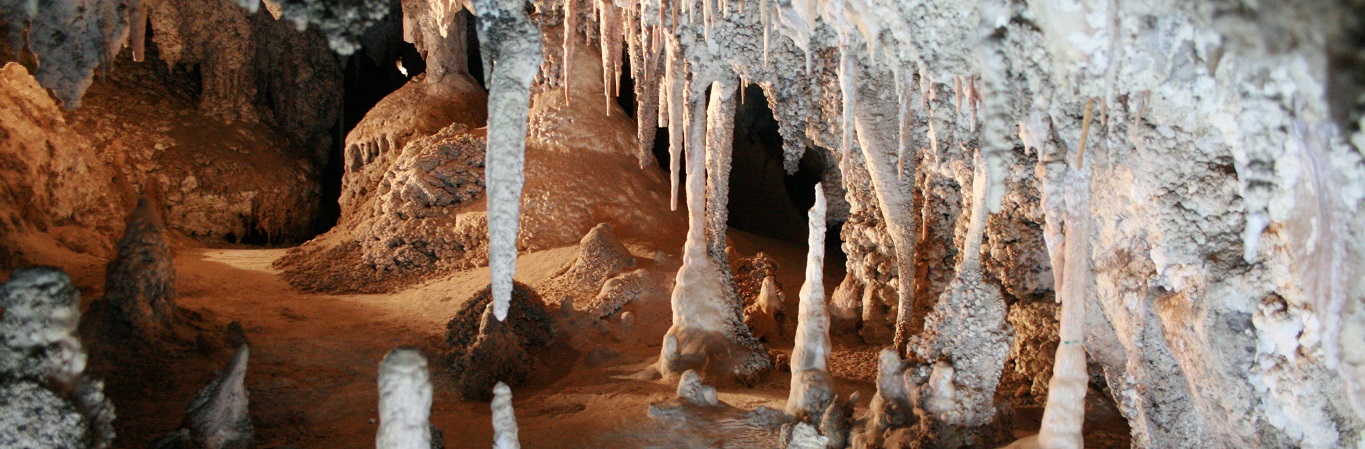
Different parts of the cave system formed through different mechanisms. Some passages, called phreatic caves, formed when the rock was fully saturated with water and dissolved from all directions. Imperial Cave includes active river caves, where water still flows through the system today. Lucas Cave’s Exhibition Chamber is a breakdown chamber, formed when the roof of a cavern collapsed under its own weight. Orient Cave’s Persian Chamber is a dome cave shaped by rising water.
The same basic chemistry, playing out across different conditions and timescales, produced an extraordinary range of shapes and spaces.
What’s Inside
The caves cover more than 40 kilometres of multi-level passageways and more than 300 entrances. Of those, 11 show caves are open to visitors with guided tours.
The Blue Lake sits inside the cave system, its distinctive blue-green colour produced by minerals dissolved in the water. Glow worms appear in select sections of the caves, visible on certain tours.
The scale of what’s underground is difficult to communicate. Photos of the formations look impressive, but they don’t tell you how small you feel standing next to a 20-metre column of calcite that took a million years to form.
Indigenous Connection
The Jenolan Caves are located on the land of the Gundungurra and Wiradjuri peoples. The Gundungurra people explored and used the caves long before European contact, and the waters were considered to have healing properties. That history predates any guided tour by a considerable margin.
Are the Jenolan Caves Worth Visiting?
Yes, with some caveats.
If you’re expecting a theme park experience, you’ll find something more demanding. The caves involve walking, ducking, and climbing at times. Some show caves cover steep ground. The temperature inside stays around 14 degrees Celsius year-round, regardless of the season outside.
Photos don’t capture it. The formations, the sense of scale, and the complete darkness when guides turn off the lights for a moment – none of that translates to a screen.
Eleven show caves sounds like a full programme, but three is a realistic number for a single day. Each cave takes between 45 minutes and two hours. Jenolan suits families, geology enthusiasts, and anyone doing their first underground experience. Allocate at least half a day. A full day is better.
How to Visit
The caves are in the Jenolan Karst Conservation Reserve, approximately three hours from Sydney by car. The roads through the reserve are narrow and winding, particularly the final descent into the valley, so allow more time than you think you need.
Self-drive is possible, but parking is limited during school holidays and peak periods. Tours from Sydney remove the logistics entirely and combine Jenolan with Blue Mountains stops like Scenic World or wildlife parks. Two-day options are worth considering if you want to do more than one cave.
Book tickets in advance. This is not optional during school holidays, long weekends or any warm weekend in spring and summer.
What to bring: sturdy walking shoes (not sandals or thongs), warm layers regardless of the weather outside, and a torch if you have one. A light jacket isn’t enough at 14 degrees if you’re underground for several hours.
Frequently Asked Questions
How old are the Jenolan Caves?
The Jenolan Caves are over 340 million years old. They are the oldest known open cave system in the world.
How were the Jenolan Caves formed?
Rainwater absorbs carbon dioxide and becomes mildly acidic. Over millions of years, this water dissolved the limestone bedrock through a process called karstification. The limestone itself formed around 430 million years ago when the region was a shallow sea.
How long does it take to tour the Jenolan Caves?
Each show cave tour takes between 45 minutes and two hours. Most visitors do two or three caves in a day. Allow at least half a day, and ideally a full day.
Are the Jenolan Caves open?
[CHECK WITH CLIENT: confirm current operating status and hours before publishing]
What is the best show cave at Jenolan?
Lucas Cave is the most popular, and Orient Cave is considered one of the most spectacular. The best cave depends on what you’re after – ask when booking.
How far is it from Sydney to the Jenolan Caves?
The Jenolan Caves are approximately three hours from Sydney by car, in the Central Tablelands of NSW.
Are the Jenolan Caves worth visiting?
Yes. Three caves in a day is a realistic target, and the experience doesn’t translate well to photos. Go to see it in person.
Do I need to book tickets for the Jenolan Caves in advance?
Yes. Especially during school holidays, long weekends, and peak season. Book through the Jenolan Caves website.

